
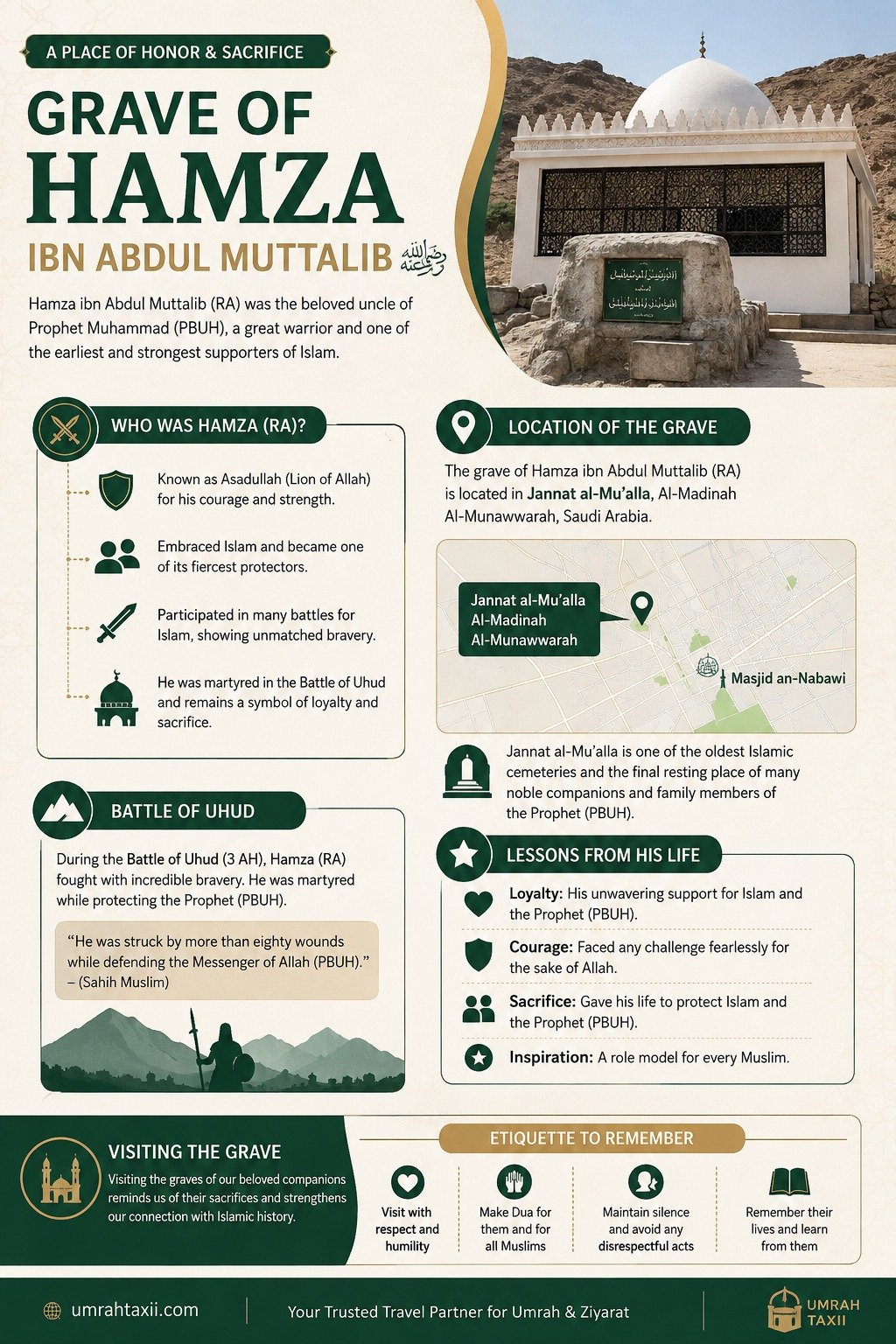
Grave of Hamza ibn Abdul Muttalib (RA): Location, History and Complete Ziyarat Guide
There are graves in Madinah that make you pause. The grave of Hazrat Hamza ibn Abdul Muttalib (RA) is one of them. Tucked within the Shuhada Uhud Cemetery at the foot of Mount Uhud, approximately 5 kilometres north of Masjid an-Nabawi, this simple, unadorned resting place belongs to one of the greatest figures in Islamic history — the Lion of Allah, the Chief of Martyrs, the beloved uncle of the Prophet Muhammad (PBUH).
For millions of pilgrims who travel to Madinah for Umrah and Hajj each year, visiting the grave of Hamza (RA) is among the most emotionally powerful moments of their entire journey. This complete guide by Umrah Taxii covers everything you need to know — who Hamza (RA) was, what happened at the Battle of Uhud, where the grave is located, and how to visit it respectfully and meaningfully.
Who Was Hazrat Hamza ibn Abdul Muttalib (RA)?
Hazrat Hamza ibn Abdul Muttalib (RA) was born in Makkah approximately two years before the Prophet Muhammad (PBUH), around 568 CE. He was the son of Abdul Muttalib ibn Hashim and Hala bint Wuhayb, making him the full paternal uncle of the Prophet (PBUH). In a remarkable bond that went beyond blood, he was also the Prophet’s milk brother — both having been nursed by the same woman, Thuwayba al-Aslamiyya, the freed slave of Abu Lahab.
Even before Islam, Hamza (RA) was already one of the most respected men in all of Makkah. He was known throughout the Quraysh tribe for extraordinary physical strength, unmatched courage in battle, and a noble character that commanded the respect of both allies and enemies. He was also a celebrated hunter — skilled, fearless, and utterly composed under pressure.
The Prophet Muhammad (PBUH) himself described his uncle in words that have echoed through Islamic history:
“The best of my uncles is Hamza ibn Abdul Muttalib.”
These words, coming from the Seal of the Prophets, tell us everything about the rank Hamza (RA) holds in Islam.
How Hazrat Hamza (RA) Embraced Islam
The story of how Hamza (RA) accepted Islam is one of the most dramatic conversion stories in early Islamic history — driven not by quiet reflection but by righteous anger in defence of the Prophet (PBUH).
One day, while returning from a hunt, Hamza (RA) was informed that Abu Jahl — the most hostile enemy of the Prophet (PBUH) at the time — had publicly insulted and physically abused the Prophet (PBUH) near the mount of Safa. Hamza (RA), still carrying his bow, went directly to Abu Jahl and struck him on the head, saying:
“You dare insult him? I am on his religion. I bear witness that he is the Messenger of Allah.”
This spontaneous declaration of faith — made in fury and love, not after careful deliberation — was accepted by Allah, and Hamza (RA) became Muslim around the 6th year of Prophethood, approximately 616 CE. His conversion was immediately felt across Makkah. Abu Jahl and his allies, who had grown increasingly bold in their persecution of the early Muslims, became notably more restrained once they knew Hamza stood behind the Prophet (PBUH).
The impact of his conversion is captured in a narration recorded by Ibn Hisham: when Hamza accepted Islam, the Quraysh realised that the Prophet now had a protector who would not be intimidated. The early Muslim community, which had suffered years of torture, boycott and persecution, felt a tangible wave of relief.
Hamza (RA) in the Early Years of Islam
After accepting Islam, Hamza (RA) threw himself completely into the service of the Prophet (PBUH) and the Muslim community. His contributions in the formative years of Islam cover both spiritual and military dimensions.
His Role as a Protector of the Prophet (PBUH)
In the years before the Hijrah to Madinah, the Muslims in Makkah were a vulnerable minority. Hamza (RA) acted as a personal shield for the Prophet (PBUH) — his physical presence and fearsome reputation deterring many attacks that might otherwise have occurred. His acceptance of Islam is widely cited by historians as a turning point in the early Muslim community’s ability to practice their faith more openly.
The First Expedition of Islam
When the Prophet (PBUH) arrived in Madinah after the Hijrah in 622 CE, one of the very first military expeditions he dispatched was led by Hamza (RA). Known as the Expedition of Hamza (Sariyya Hamza), it was sent to intercept a Qurayshi caravan near the coast of the Red Sea at a place called Sif al-Bahr. The expedition involved approximately 30 to 40 Muhajirun fighters. While no battle took place — the two sides separated without engagement — the expedition established the principle of active Muslim defence of their community and trade routes. Hamza (RA) carrying the very first military banner of Islam is a moment of profound historical significance.
The Battle of Badr — 624 CE
Hamza (RA) fought with extraordinary distinction at the Battle of Badr in 624 CE, the first major pitched battle in Islamic history. He was one of the most feared warriors on the Muslim side, killing multiple enemy fighters including Shaybah ibn Rabi’ah, one of the most formidable Qurayshi commanders. His performance at Badr cemented his reputation as the single most dangerous fighter in the Muslim army and earned him the title Asadullah — the Lion of Allah.
The Battle of Uhud and the Martyrdom of Hamza (RA)
The Battle of Uhud, fought on 7 Shawwal 3 AH (625 CE) at the foot of Mount Uhud near Madinah, is one of the most significant and emotionally charged battles in Islamic history. It is also the battle in which Hazrat Hamza (RA) was martyred — a loss so devastating that it brought the Prophet Muhammad (PBUH) to tears unlike any other event in his life.
Background — The Quraysh March on Madinah
After their crushing defeat at the Battle of Badr, the Quraysh of Makkah spent an entire year preparing for revenge. They assembled a force of approximately 3,000 fighters — compared to the Muslim army of around 700 — under the command of Abu Sufyan ibn Harb. The explicit objective of the campaign was revenge for Badr, and the Qurayshi leaders made no secret of their desire to kill the Prophet (PBUH) and his closest companions — particularly Hamza (RA), whose performance at Badr had humiliated the most powerful families of Makkah.
Hind bint Utbah, wife of Abu Sufyan and one of the most powerful women of the Quraysh aristocracy, had a deeply personal motive. Her father Utbah, her brother Walid, and her uncle Shaybah had all been killed at Badr — and Hamza (RA) had been involved in their deaths. She made a specific arrangement to ensure Hamza’s death: she hired an Abyssinian slave named Wahshi ibn Harb, who was renowned for his exceptional skill with the javelin, and promised him his freedom in exchange for killing Hamza (RA).
The Battle
The early stages of the Battle of Uhud went in favour of the Muslims. Hamza (RA) fought with his characteristic ferocity — the narrations describe him sweeping through the Qurayshi ranks like a force of nature, his battle cry of “I am the lion of Allah and the lion of His messenger” striking fear into enemy hearts. He killed an extraordinary number of enemy fighters in this engagement, according to multiple narrations in the books of Islamic history.
The tide turned when a group of Muslim archers stationed on a small hill — placed there under explicit orders from the Prophet (PBUH) not to leave their position under any circumstances — abandoned their posts when they saw the Qurayshi lines beginning to break, assuming the battle was won. Khalid ibn al-Walid, then commanding a Qurayshi cavalry unit, immediately exploited the gap and outflanked the Muslim army. What had been a Muslim victory became a crisis within minutes.
It was in this chaos that Wahshi ibn Harb executed the plan Hind had commissioned. He positioned himself carefully, waited for Hamza (RA) to become engaged with another fighter, and hurled his javelin with lethal precision. Hamza (RA) fell, mortally wounded. He died on the battlefield of Uhud.
Wahshi later narrated the killing himself, and his account is recorded in Sahih al-Bukhari. He described watching Hamza (RA) fight — acknowledging his power and ferocity — before finding the precise moment to strike.
The Prophet’s (PBUH) Grief
When the Prophet Muhammad (PBUH) came upon the body of Hamza (RA) after the battle, what he saw broke him in a way that companions had never witnessed before. Hind bint Utbah, in an act of mutilation, had ordered the bodies of the Muslim martyrs to be desecrated — she herself cut open Hamza’s body and extracted his liver, an act that the Prophet (PBUH) described as among the worst violations of the sanctity of the dead.
The Prophet (PBUH) stood over the body of his uncle and wept. Multiple narrations confirm that his grief at Uhud was unlike anything companions had seen before or would see again. He said:
“Were it not that Safiyya would grieve and it would become a Sunnah after me, I would leave him as he is so that he would be gathered in the bellies of wild animals and birds.” (Ibn Hisham, Sirah an-Nabawiyyah)
He gave Hamza (RA) the title Sayyid al-Shuhada — the Chief of all Martyrs — a title that belongs to him alone in Islamic tradition.
The Prophet (PBUH) personally performed the funeral prayer over Hamza (RA) seventy times — once for each of the seventy martyrs of Uhud, and then specifically for Hamza (RA) each time.
Titles and Honours of Hazrat Hamza (RA)
Hazrat Hamza ibn Abdul Muttalib (RA) holds several honourable titles in Islamic tradition, each reflecting a different dimension of his greatness:
Asadullah — Lion of Allah: Awarded for his ferocity and courage in battle, particularly at Badr and Uhud. The Prophet (PBUH) himself used this title.
Asad ar-Rasul — Lion of the Messenger: Given by the Prophet (PBUH) as a personal title acknowledging Hamza’s role as his fiercest defender.
Sayyid al-Shuhada — Chief of Martyrs: The highest title given to any martyr in Islamic history. The Prophet (PBUH) said: “The chief of martyrs is Hamza ibn Abdul Muttalib.” (Al-Hakim, Mustadrak)
Amir al-Mujahideen — Leader of the Fighters in the Path of Allah: A title reflecting his role as the foremost warrior in the early Muslim armies.
Where is the Grave of Hamza (RA) Located?
The grave of Hazrat Hamza (RA) is situated in a small enclosure at the base of Mount Uhud, surrounded by other graves of the martyrs who died in the Battle of Uhud. More precisely: Umrah Taxii.
Location: Shuhada Uhud Cemetery (Maqbara Shuhada Uhud), at the foot of Mount Uhud on its southern side
Distance from Masjid an-Nabawi: Approximately 5 kilometres north of the Prophet’s Mosque
Address: Sayed Al Shuhada, Madinah 42321, Saudi Arabia
GPS Coordinates: Approximately 24.5014° N, 39.6128° E
The grave of Hamza (RA) is the most prominent and best-marked grave within the Uhud Martyrs Cemetery. It sits slightly elevated within a simple green-painted enclosure, clearly distinguishable from the surrounding graves of other martyrs. The grave is marked but simple, with no impressive adornment and no ornate mausoleum — a simplicity that is deeply in keeping with Islamic principles about graves and one that carries its own powerful message about humility before Allah.
Buried alongside Hamza (RA) in the same enclosure is his nephew Abdullah ibn Jahash (RA), who was also martyred at Uhud. The original tomb was built during the reign of al-Nasir li-Din Allah and later renovated during the Ottoman era, most likely in the mid-nineteenth century. It was demolished during the demolitions campaign of 1926 and the complex was divided into two separate structures — the Uhud Martyrs enclave and Sayyid al-Shuhada Mosque. Wikipedia
Adjacent to the grave is Masjid Sayyid al-Shuhada — a small mosque built near the site where the Prophet (PBUH) prayed the funeral prayer over the martyrs of Uhud. Pilgrims typically offer two rakats of prayer in this mosque as part of their Ziyarat visit.
What the Prophet (PBUH) Said About Visiting Uhud
The grave of Hamza (RA) and the site of the Battle of Uhud carry special significance in hadith, with the Prophet (PBUH) himself expressing a deep and ongoing connection to this place even after his death:
“Uhud is a mountain that loves us and we love it.” (Sahih al-Bukhari)
“The chief of martyrs is Hamza ibn Abdul Muttalib, and a man who stands up to a tyrant ruler and commands him to do good and forbids him from evil and is killed for it.” (Al-Hakim, Mustadrak — classified Sahih)
“By Allah, I will surely visit you.” — The Prophet (PBUH) is reported to have said this about the martyrs of Uhud, and narrations describe him visiting this site regularly throughout the rest of his life in Madinah.
The Companions of the Prophet (RA) also continued to visit the grave of Hamza (RA) after the Prophet’s death. It is narrated that Safiyya bint Abdul Muttalib (RA), sister of Hamza, visited his grave to mourn him — and the Prophet (PBUH) permitted this, offering dua for Hamza and the other martyrs.
How to Visit the Grave of Hamza (RA) — Complete Practical Guide
Getting There from Madinah
The Grave of Hamzah is located near the Uhud Mountain, around 5 kilometres from the Prophet’s Mosque in Madinah. To get there, you can take a taxi or hire a private car, which will take approximately 15 minutes from the city centre. Al Fateh Transport
Umrah Taxii provides private, air-conditioned transport from Masjid an-Nabawi and all Madinah hotels directly to Mount Uhud and the grave of Hamza (RA). We include this site in our comprehensive Madinah Ziyarat tour, which also covers Masjid Quba, Jannat al-Baqi, Masjid al-Qiblatayn, and other major Islamic sites in and around Madinah. Contact us via WhatsApp to arrange your transport before or during your Umrah visit.
What to Do When You Arrive
1. Begin with a visit to the Battle of Uhud site. Before approaching the grave, walk the battlefield briefly. Understand where the Muslim archers were stationed, where the Qurayshi cavalry broke through, and where the main fighting took place. This context transforms the grave visit from a simple stop into a deeply meaningful reflection on sacrifice, obedience, and divine wisdom.
2. Visit Masjid Sayyid al-Shuhada. The small mosque adjacent to the cemetery is where the Prophet (PBUH) led the funeral prayers for the martyrs. Offer two rakats of prayer here before proceeding to the graves.
3. Approach the grave of Hamza (RA) with reverence. Stand facing the grave and make salaam: “Assalamu alaykum ya ahl al-qubur” (Peace be upon you, O people of the graves). This is the Sunnah greeting for graves established by the Prophet (PBUH) himself.
4. Make dua facing the Qibla — not facing the grave. Islamic scholars clarify that when making dua at graves, pilgrims should face the Qibla (direction of Makkah), not the grave itself. Dua is made to Allah, asking Him to have mercy on the deceased and on the visitor.
5. Recite Surah al-Fatiha. Reciting al-Fatiha and sending its reward to the deceased is a widely practiced act at graves of the righteous. Ask Allah to accept Hamza’s martyrdom, to grant him the highest stations of Jannah, and to allow his intercession on the Day of Judgement.
6. Reflect, do not rush. Many pilgrims spend only a few minutes at this grave because tour groups move quickly. If possible, spend 15 to 20 minutes here. Think about what Hamza (RA) gave up — his life, his body’s sanctity — for the sake of the religion you practice today. Let the weight of that sink in.
Practical Visiting Information
| Detail | Information |
|---|---|
| Location | Shuhada Uhud Cemetery, Mount Uhud, Madinah |
| Distance from Masjid an-Nabawi | 5 kilometres north |
| Travel time by car | 10 to 15 minutes |
| Opening hours | Open to visitors throughout the day |
| Best time to visit | Early morning after Fajr or late afternoon before Maghrib |
| Facilities | Masjid Sayyid al-Shuhada nearby, parking available |
| Dress code | Modest Islamic dress; women to wear full hijab |
| Photography | Permitted of the site; avoid photographing other pilgrims without permission |
| Transport from Madinah | Umrah Taxii — private air-conditioned vehicles available 24/7 |
Best Time to Visit
The best time to visit the Grave of Hamzah is early in the morning or later in the evening, especially during the cooler months of November to March. During summer months (May to September), temperatures around Mount Uhud can reach 42 to 46 degrees Celsius in the afternoon. Visiting after Fajr prayer in the early morning allows you to experience the site in relatively cool temperatures and in the spiritually elevated state following dawn prayer.
The Emotional Experience of Visiting
No amount of writing can fully prepare a pilgrim for what they feel standing at the grave of Hamza (RA). The gravesite of Hamza ibn Abdul Muttalib is more than just a physical location — it represents the unyielding spirit of Islam’s early followers. Pilgrims and visitors from around the world visit this sacred site to pay their respects and to reflect on the courage and sacrifice that shaped the religion in its formative years. Al Fateh Transport
Many pilgrims weep. Some stand in complete silence. Others recite salawat on the Prophet (PBUH) — knowing that the man buried here loved the Prophet more than he loved his own life and proved it at the cost of everything. Every Muslim alive today who practices this religion owes something to people like Hazrat Hamza (RA) — and standing at his grave is one of the rare moments in life when that debt becomes viscerally, undeniably real.
Frequently Asked Questions About the Grave of Hamza (RA)
-
Q.Where is the grave of Hamza ibn Abdul Muttalib located?
Answer,The grave of Hazrat Hamza (RA) is located in the Shuhada Uhud Cemetery at the foot of Mount Uhud, approximately 5 kilometres north of Masjid an-Nabawi in Madinah, Saudi Arabia. The address is Sayed Al Shuhada, Madinah 42321, Saudi Arabia.
-
Q.How do I get to the grave of Hamza from Masjid an-Nabawi?
Answer,The most convenient way is by private taxi or private vehicle. The journey takes approximately 10 to 15 minutes by car. Umrah Taxii provides dedicated Madinah Ziyarat transport including visits to Mount Uhud and the grave of Hamza (RA). WhatsApp us to arrange your booking.
-
Q.Is visiting the grave of Hamza (RA) part of the Madinah Ziyarat?
Answer,Yes. The grave of Hamza (RA) and Mount Uhud are among the most important and most visited sites in the standard Madinah Ziyarat itinerary, alongside Masjid Quba, Jannat al-Baqi, and Masjid al-Qiblatayn.
-
Q.Who killed Hamza (RA) at the Battle of Uhud?
Answer,Hazrat Hamza (RA) was killed by Wahshi ibn Harb, an Abyssinian slave who was promised his freedom by Hind bint Utbah if he killed Hamza. Wahshi used a javelin, for which he was renowned. He later accepted Islam and deeply regretted his role in Hamza's death.